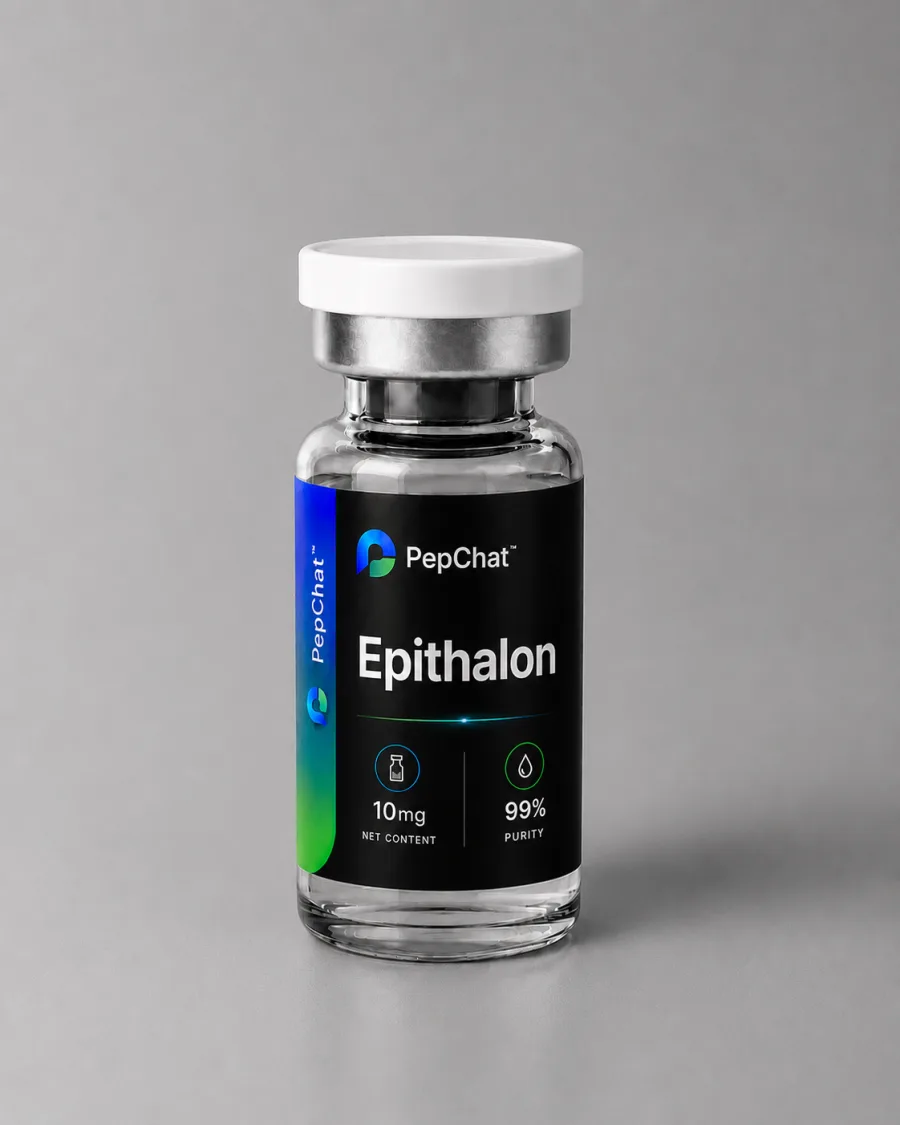
Epithalon (also written epitalon or epithalone) is a four-amino-acid peptide, Ala-Glu-Asp-Gly, designed in the 1980s at the St Petersburg Institute of Bioregulation and Gerontology as a synthetic version of epithalamin, a peptide extract of the bovine pineal gland. Its research profile is unusual: a small molecule, a very long history, and a literature dominated by a single institute. Understanding it starts with the biology it is measured against.
Telomeres and telomerase
Telomeres are repetitive DNA sequences (TTAGGG in humans) capping the ends of chromosomes. Each round of cell division shortens them, because DNA polymerase cannot fully copy the very end of a linear chromosome. When telomeres become critically short the cell stops dividing, a state called replicative senescence, first described by Leonard Hayflick in 1961. Telomerase is the enzyme that rebuilds telomeres; it is active in germ cells, stem cells and most cancers, and largely silent in ordinary adult somatic cells. Anything that changes telomerase activity in somatic cells is therefore of interest to ageing research, and equally to cancer biology.
What Khavinson's group reported
The most cited paper is Khavinson, Bondarev and Butyugov (2003), which reported that epithalon induced telomerase expression, activity and telomere elongation in cultured human fetal fibroblasts that had not previously expressed the enzyme; a follow-up from the same group reported treated cultures dividing beyond the Hayflick limit. The same group has published work on epithalon in ageing rodents and in long-term observational studies of elderly patients given peptide bioregulators, reporting effects on melatonin rhythms, oxidative-stress markers and mortality. Across these papers the proposed mechanism is regulation of gene expression, including the telomerase reverse transcriptase gene, rather than action at a cell-surface receptor.
How to weigh that evidence
Three points are important. First, the telomerase finding comes from cell culture in one laboratory and has not been replicated in an independent, peer-reviewed study of comparable design. Second, telomerase activation is not straightforwardly desirable: the same enzyme that lets senescent cells keep dividing is what allows tumour cells to become immortal, which is why the field treats it with caution. Third, the human studies from the institute are observational, small, and published mostly in Russian-language journals with translated abstracts; they are hypothesis-generating rather than confirmatory. None of this makes the work wrong. It means the peptide's profile rests on a narrower base than its reputation suggests.
What is being studied now
Interest in epithalon today is largely as a tool compound in ageing research: a small, cheap, well-defined molecule to test against telomerase assays, senescence markers and circadian endpoints in cell and animal models. Its short length makes it easy to synthesise at high purity, and its mechanism, if confirmed, would be a useful probe for how short peptides influence transcription. Studies using it should specify the model, the exposure and the assay, since the effect reported in 2003 was in one cell type under one set of conditions.
Key takeaways
- Epithalon is the synthetic tetrapeptide Ala-Glu-Asp-Gly, derived from pineal-gland extracts.
- Telomeres shorten with each division; telomerase rebuilds them and is normally silent in adult somatic cells.
- The key claim, telomerase induction in cultured fibroblasts, comes from one group and lacks independent replication.
- Telomerase activation carries cancer-biology caveats, and the human data are observational.